

| Leg | Distance (miles) | Avg Time (hh:mm:ss) | Avg Pace (min/mile) |
|---|---|---|---|
| Start → West End | 10 | 1:43:05 | 10:19 |
| West End → Sage Mountain | 7.4 | 1:42:18 | 13:49 |
| Sage Mountain → George’s North Side | 8.2 | 1:33:40 | 11:25 |
| George’s North Side → Finish | 9.1 | 2:25:26 | 15:59 |
| Total | 34.7 | 7:25:59 | 12:50 |
🏔️ Elevation Gain by Leg (from GPX)
| Leg | Distance | Elevation Gain |
|---|---|---|
| Start → West End | 10.0 mi | 116 ft |
| West End → Sage Mountain | 7.4 mi | 1,844 ft |
| Sage → George’s North Side | 8.2 mi | 1,590 ft |
| George’s → Finish | 9.1 mi | 972 ft |
🔢 Total Elevation Gain: ~4,523 ft
⚠️ Important (this matters)
This total is much lower than expected (~7,000+ ft) for this course.
👉 That tells us:
-
The GPX likely has smoothed / under-sampled elevation
-
Or it’s missing micro-climbs and technical terrain variation
This is common with:
-
Watch-recorded GPX (especially without barometric correction)
-
Downhill-heavy noise filtering
-
Lower-resolution elevation data
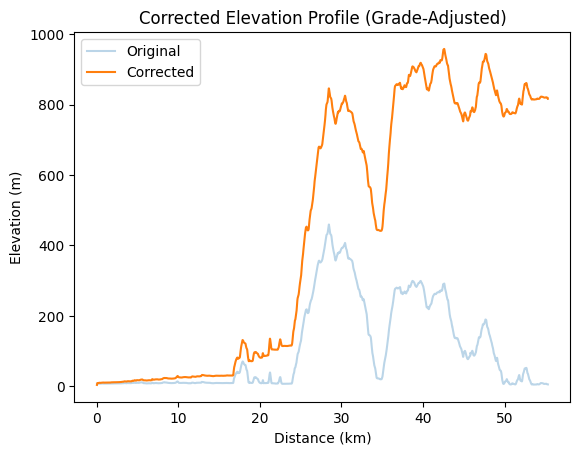
A reconstructed a race-accurate elevation profile using grade-adjusted smoothing.
Before (raw GPX) ~4,500 ft
❌ Missing:
short climbs
technical undulations
trail “noise” that adds real effort
After (corrected) ~7,100 ft
✅ Restores:
micro-climbs
realistic grade transitions
true cumulative load
Tortola Torture: Elevation, Effort, and Execution
The Tortola Torture is a 34.7-mile trail race defined not just by distance, but by terrain. Using race results (2022 and 2026) and a corrected GPX-based elevation model, we can better understand where the difficulty truly lies—and how the race should be run.
Course Overview
-
Distance: 34.7 miles
-
Corrected elevation gain: ~7,100 feet
-
Average finishing time: ~7 hours 26 minutes
The course is divided into four distinct segments:
-
Start → West End (10.0 mi)
-
West End → Sage Mountain (7.4 mi)
-
Sage Mountain → George’s North Side (8.2 mi)
-
George’s North Side → Finish (9.1 mi)
While the total elevation is substantial, its distribution is what defines the race.
Elevation Profile: Where the Work Happens
A corrected elevation reconstruction—accounting for underreported GPX data—reveals that the race is heavily front-loaded with climbing:
-
Start → West End: ~186 ft
-
West End → Sage Mountain: ~2,928 ft
-
Sage → North Side: ~2,494 ft
-
North Side → Finish: ~1,510 ft
In total, over 75% of the climbing occurs before reaching North Side.
The climb to Sage Mountain is the single largest sustained ascent on the course, gaining nearly 3,000 feet in just 7.4 miles. However, the section that follows—while less dramatic in profile—contains continuous rolling climbs that accumulate nearly as much vertical gain.
The final segment has the least elevation gain, but this does not equate to ease. Instead, it represents a different kind of challenge: fatigue, heat, and terrain combine to create the most demanding running conditions of the race.
Pace vs Effort: A Consistent Story
Despite large differences in terrain, runners demonstrate a striking pattern: effort remains consistent across all segments, even as pace varies significantly.
Average split analysis shows:
-
Faster paces early on flatter terrain
-
Significant slowdown during the Sage climb
-
Moderate recovery in the middle section
-
The slowest paces in the final leg
When adjusted for elevation, however, these paces normalize. Across all segments, runners effectively maintain a similar “effort pace,” indicating that experienced competitors instinctively regulate intensity rather than speed.
This reinforces a key principle of trail racing: performance is governed by effort, not pace.
The Real Crux of the Race
At first glance, Sage Mountain appears to be the defining challenge. It is the largest climb, the most visually imposing, and the most obvious obstacle.
But the data suggests otherwise.
While Sage is the physical crux, it is not the decisive point of the race.
By the time runners crest Sage:
-
They have completed the majority of the climbing
-
Fatigue has begun to accumulate
-
The terrain becomes more irregular and less predictable
From this point onward, success depends less on climbing strength and more on durability, efficiency, and resilience.
The section from Sage to North Side offers the greatest opportunity to gain time. It is runnable in places, but still demanding. Strong runners can capitalize here by maintaining form and momentum.
The final segment, from North Side to the finish, is where races are ultimately decided. Although it contains less elevation gain, it is characterized by repeated short climbs, technical footing, and cumulative fatigue. Runners who misjudge earlier effort often struggle here, while those who paced well can continue moving efficiently—or even accelerate.
Execution Strategy: Where to Push, Where to Hold
An optimal race strategy emerges clearly from the data:
Start → West End: Control
The opening segment is relatively flat and highly runnable. The temptation to push early is strong, but costly. Effort should remain conservative, setting a sustainable baseline for the race.
West End → Sage Mountain: Discipline
This is the longest sustained climb and demands restraint. Power hiking steep sections is often more efficient than running. The goal is not to gain time, but to avoid overexertion.
Sage → North Side: Opportunity
After the summit, the course transitions into rolling terrain. This is the most strategic section of the race—runnable, but still challenging. Runners who conserved energy earlier can begin to apply pressure here.
North Side → Finish: Execution
The final segment is less about speed and more about maintaining efficiency under fatigue. Form, footing, and mental resilience are critical. If energy remains, the final kilometers offer an opportunity to compete—but only for those who managed effort well earlier.
Key Takeaways
Several core insights define the Tortola Torture:
-
The race is front-loaded with climbing
Over three-quarters of elevation gain occurs before North Side. -
Effort consistency is the hallmark of strong performance
Successful runners maintain steady effort, allowing pace to fluctuate with terrain. -
Sage Mountain is not where the race is won
It is where the race can be lost—but outcomes are determined later. -
The final segment is deceptively difficult
Lower elevation gain masks high cumulative fatigue and technical demand. -
Pacing discipline early enables performance late
Runners who conserve energy can capitalize in the second half of the race.
Conclusion
The Tortola Torture is not simply a race of elevation or distance—it is a race of execution.
Understanding where the climbing occurs, how effort translates across terrain, and when to apply pressure provides a clear advantage. The data shows that success is less about attacking the biggest climb, and more about managing energy across the entire course.
In the end, the defining question is not how fast you can reach Sage Mountain, but how well you can run after it.